Our second "Chi-Tie" downtown Chicago flytying social event will be tomorrow night (Monday, March 11, 2013) as scheduled, from 6:30pm until 9:30pm. We'll be at a basement bar called "Galway Bay" at 500 W. Diversey. Kurt Kopala, editor of A Tight Loop magazine, will be doing a demo tie of a Kelly Galloup pattern. We will also be collecting flies for a donation to the Tie-A-Fly Giveaway to benefit flyfishing charity groups. You can donate the flies you tie or bring some from home. Come on down, have a good drink, some laughs, swap fish stories, make fishing plans, tie some flies, and help some charities. Represent and reinforce Chi-town's great flyfishing community.
See you all there,
-T.A.
PS. Pedestal vises are encouraged.
Sunday, March 10, 2013

Saturday, March 9, 2013
Bugging Me
I've been squeezing in an hour or two at the vise when I can, and below are some recent bugs. I've been so busy lately that it's been hard to get solid vise-time in. It bugs me to not tie bugs. Since I don't tie for a living, there's the working me and the 'bugging me.'
With little time in each session, I've gone with different styles and forage for each sitting. Tiny crayfish, meaty crayfish, small minnows, and wide-bodied baitfish.


Don't forget, if you're in Chicago this Monday, March 11, stop by the Chi-Tie social flytying event at Galway Bay, 500 W Diversey from 6:30pm-9:30pm. Must be 21 or older. See you there!
With little time in each session, I've gone with different styles and forage for each sitting. Tiny crayfish, meaty crayfish, small minnows, and wide-bodied baitfish.


Don't forget, if you're in Chicago this Monday, March 11, stop by the Chi-Tie social flytying event at Galway Bay, 500 W Diversey from 6:30pm-9:30pm. Must be 21 or older. See you there!
Tuesday, February 12, 2013
Post-Mayan Fly Tyin': The Premier of "Chi-Tie"
About a month ago, Dave from Urban Assault Fly Fishing, a fellow Chicago city resident, came to me with the idea for a "bar flies" type tying event right here in the city. I had seen the pictures from other cities' similar events on Facebook and had been envious. Why shouldn't all fly tyers have a local community? In Chicago, especially, many anglers do not know each other. We sneak out to the Lakefront or Chicago River for a few hours here and there--but with all the concrete in between, we seem to overlook each other.

So anyway, we found a great basement bar--Galway Bay--a few blocks from a very fishy harbor and did the first trial event last night. We were joined by Isaac from Wig Bags (check him out--he makes awesome custom bags for any purpose). Dave and Isaac can tie some flies. Between all of us, there was a nice variety of bugs on the table. The bar staff were cool, too, hanging out around the table to watch and ask about local fishing. Bill, the bartender, even offered up a free round of shots to celebrate our first event.

We are hoping this event grows to become a regular thing with many more participants from the city and surrounding area. Time will tell. We'll be working on recruitment and promotion in the weeks to come. Dave already has a cool "Chi-Tie" logo in the works. Keep an eye out for the final draft.


So anyway, we found a great basement bar--Galway Bay--a few blocks from a very fishy harbor and did the first trial event last night. We were joined by Isaac from Wig Bags (check him out--he makes awesome custom bags for any purpose). Dave and Isaac can tie some flies. Between all of us, there was a nice variety of bugs on the table. The bar staff were cool, too, hanging out around the table to watch and ask about local fishing. Bill, the bartender, even offered up a free round of shots to celebrate our first event.

We are hoping this event grows to become a regular thing with many more participants from the city and surrounding area. Time will tell. We'll be working on recruitment and promotion in the weeks to come. Dave already has a cool "Chi-Tie" logo in the works. Keep an eye out for the final draft.
Thanks to Isaac of Wig Bags for the following pics


See you at the next Chi-Tie in March!
-T.A.
Saturday, February 9, 2013
Is the "Generation Gap" Fishing's Biggest Gap?
There has been a decent amount of chat lately about the supposed 'generation gap' in flyfishing. Obviously generational concerns about fishing date back a while. But in the past week or so, I believe it started with FishCampRehab's "Standing in the Generation Gap," which inspired Mike Schmidt of Anglers Choice to write "Some Thoughts from the Middle." As I said in my recent post, I thought these were thought-provoking and socially-oriented posts that both made good points. What I took from this conversation is that there is at least a sentiment among anglers that flyfishing has a cultural divide along age lines--young anglers use multimedia to document their trips, are image-conscious, and are always ready to act, whereas the old guard wants to have more meetings to talk about fishing and plan for action. Those in the middle just feel sort of hybridized by their participation in both cohort cultures.
This got me thinking about what other demographic 'gaps' we have in flyfishing and fishing in general. I dug up several yearly reports from TakeMeFishing.org (henceforth 'TMF'), an organization that studies fishing and boating participation in order to grow these markets (yes, they see us as markets). Given that statistical data is difficult to come across on the topic of fishing, I used these TMF reports to try to answer the question of 'gaps.'
So what does the generational spread of flyfishing look like, statistically?
 |
| Percentage of Flyfishing Participants by Age Group |
[There are some problems with this portrayal that aren't my doing. Without having access to the raw data, I couldn't slice up these cohorts in a way that might match with other anglers' discussions about generation gaps.]
So what about other gaps? Is age the only numerical and cultural 'tectonic plate' in flyfishing? Well, looking at the figures for sex (gender) from the same 4 annual TMF reports, we see that women are far less likely than men to be fly anglers. In fact, the sex gap in flyfishing is bigger than in fishing on the whole (which includes flyfishing and all conventional fishing combined). When I averaged the 4 figures for women's share of the fishing population, women comprised an estimated 33% of the entire fishing population, but they were 23% of flyfishing anglers.
 |
| Percentage of Anglers that are Women, by Fishing Mode |
That means that 1 in every 3 people that fish in the U.S. are women. And between 1/5 to 1/4 of fly anglers are women. This means that all fishing is disproportionately male. And of these, flyfishing is more male-dominated. Do these figures surprise you? I'll admit I was a bit surprised by both the size of the all-fishing share that women claimed and the gap between types of fishing. Regarding the all-fishing population, I did not expect women to be this populous. On the one hand, I knew they were out there, but women do not seem to be proportionately represented in mainstream fishing media (This claim requires more data to ascertain, of course. But think about how when women are present in fishing media, it's often confined to separate, female-designated areas of the medium--e.g. The Drake magazine's "Page Six Chix").
An interesting complication to this sex-difference story appears when we cross sex and race/ethnicity. In another report by TMF's researcher group specifically about the growing Hispanic "niche," I found that they estimated 53% of all Hispanic anglers to be women. So fishing is actually more female than male for the Hispanics in the researcher's sample. I don't think a 3% lead, if not cancelled out by the margin of error anyway, is enough to justify calling it "female-dominated," but it's certainly a differently gendered phenomenon for Hispanics than for non-Hispanic whites. Since whites are about 80% of the fishing population, the relatively low proportions of women anglers in the figures shown above are due to relatively lower participation among women in the white population.
And, of course, not all participation is equal. Not only do we not know from these reports if women spend as much time fishing per year as men, on average, we don't gain any insights into the qualitative experiences of women in fishing or the causal links between sex or race/ethnicity and fishing participation. What do these figures mean for how our fishing industry and culture operate? How are women being integrated or excluded from fishing and flyfishing culture? What are their experiences? We should not assume that the demographic makeup of fishing or flyfishing owes itself entirely to voluntary choices or differences in taste.
 |
| (Women in Waders Calendar) Really? They're not even waders! |
I'm not saying we're stuck here--things do seem to be changing toward inclusion. But change is always uneven and often slow. Keeping an eye on things will help us achieve whatever result it is that we want.
So is the generation gap the biggest gap in fishing? In fly fishing? Well, it depends what numbers you have and what you compare them to. Beyond the statistics, those are not answerable questions without a lot more information. But hopefully we have put some things in perspective with the information we do have. And of course, we've opened up a whole lot of new questions to be answered later, too.
 |
| Pboto credit: the-word-blog.com |
-T.A.
Monday, February 4, 2013
Examples of Good Fish-Out-of-Water Thinking
I give credit where it's due. Although my most recent post was to call attention to the lack of socially-conscious fishing journalism, several pieces come to mind that deserve mention and serve as examples of the socially aware outdoor journalist.

Now go read some of this stuff!
-T.A.

(1) This FishCamp piece and Mike Schmidt's response focused on the issue of a 'generation gap' in flyfishing. The authors tussle with the perhaps divergent ways of participating in flyfishing between the 'old guard' and the 'new school' (anglers over 55 and under 30, respectively, I'm assuming). Even though the authors arrive at slightly distinct conclusions, they both show an awareness that the flyfishing population is not a monolith--it is not comprised of a single demographic. Moreover, flyfishing culture varies by generation, which influences how these groups relate to each other. On the one hand, older anglers want to recruit new stewards of the sport and ecosystem, so they target recruitment at young folks. But young anglers bring with them new technologies and new aesthetics which makes them fish and organize in different ways.
(2) I also recommend Jen Ripple's piece entitled, "The Sex Hatch" in the April 2012 issue of A Tight Loop, an excellent and free online fishing magazine focusing on the midwest. Jen made the point that she, as a woman angler, is still only on the river to catch fish--not for men's entertainment. That doesn't mean she doesn't enjoy looking good doing what she and all of us do (standing in a cold ass river)--in fact, she says she wants to catch the best fish and look the best while doing it. She says she is "both intimidating and approachable." What I like about Jen's piece is that she exposes a bit of the experience of being a woman in a male-dominated sport--not just how women and men interact, but how the industry has viewed and (not) accommodated women. And her strategy is unapologetic about being a woman--she isn't going to try to look like a man and just blend in. However, that doesn't mean you should ask her out.
(3) Another socially-conscious article of note was Miles Nolte's "The Harder They Come: Oi'o and Haoles" in Vol. 4, Issue 1 of The flyfish journal. In this story, Nolte alternates between a simple narration of his attempts at landing a Hawaiian bonefish and his internal monologue about the shifting economics, culture, and symbolism of the Hawaiian "paradise." Nolte explores the tensions that the expanding tourist culture and urban sprawl means for the local and native residents, including relations between them and visiting anglers.
 |
| The next, next generation |
(2) I also recommend Jen Ripple's piece entitled, "The Sex Hatch" in the April 2012 issue of A Tight Loop, an excellent and free online fishing magazine focusing on the midwest. Jen made the point that she, as a woman angler, is still only on the river to catch fish--not for men's entertainment. That doesn't mean she doesn't enjoy looking good doing what she and all of us do (standing in a cold ass river)--in fact, she says she wants to catch the best fish and look the best while doing it. She says she is "both intimidating and approachable." What I like about Jen's piece is that she exposes a bit of the experience of being a woman in a male-dominated sport--not just how women and men interact, but how the industry has viewed and (not) accommodated women. And her strategy is unapologetic about being a woman--she isn't going to try to look like a man and just blend in. However, that doesn't mean you should ask her out.
 |
| Fly color or nail color--does one matter more? |
(3) Another socially-conscious article of note was Miles Nolte's "The Harder They Come: Oi'o and Haoles" in Vol. 4, Issue 1 of The flyfish journal. In this story, Nolte alternates between a simple narration of his attempts at landing a Hawaiian bonefish and his internal monologue about the shifting economics, culture, and symbolism of the Hawaiian "paradise." Nolte explores the tensions that the expanding tourist culture and urban sprawl means for the local and native residents, including relations between them and visiting anglers.
 |
| Whose paradise? |
(4)
Although not always written out, (I applaud you for reading this far, btw) the work
by Ken Morrow is important in raising awareness. Ken is the author of The Adaptive Fly Fishing Handbook, and
he spends his life helping differently-abled individuals flyfish. His mission
statement shows his social conscience: "Reducing and eliminating the
historical barriers and pitfalls that prevent or discourage people from
enjoying the sport of fly fishing..." Even still, Ken's work is not
journalism. How are we to learn about the complications of access to flyfishing
for those differently-abled? We need stories that cover Ken and instructors
like him, as well as anglers who have faced issues of mobility and ability in
their fishing quests. (Ken's site is also responsible for the FishCamp piece I mentioned earlier).
 |
| Logo for The Adaptive Fly Fishing Handbook |
(5) Finally, I just read
the newest edition of This is Fly,
which featured two articles on the impact of Hurricane Sandy to the Northeast
coast. These stories do a good job of focusing on communities and how external
events can influence fish, ecosystems, fishing communities, and one's own
desires to keep fishing.
 |
| But seriously, it was bad. |
New
socially-conscious journalism can range from first-person anecdotal data,
memoirs, perspectives about one's own experiences and identities to analyses of
population-level data. Reports such as those done annually by TakeMeFishing.org
(like this one) are reliable sources
for just a task.
-T.A.
Sunday, February 3, 2013
Thinking Like a Fish Out of Water
"To catch fish, sometimes you have to think like a fish."
We've all heard that statement before. Sometimes it's advice; sometimes it's a tourney angler's clever way to compliment himself. Whatever the context, "thinking like a fish" is an ever-present and pervasive mantra of our fishing world. Even the popular "match the hatch" has the same goal in mind. And for all we know, thinking like a fish has most likely caught us more fish.
The trouble with thinking like a fish is that we become entranced in this fish-like state, so focused on what fish do, where they live, and how to get them to eat. We spend long periods of time losing sight of the fact that we are human and not piscine. Fish live in water. And thinking like a fish means not thinking about the water.
"But, wait" you say, "fish have to know a lot about water, how to navigate different flows, how to most effectively find food, and whatnot." But that is a reflection of our thinking about water. The fish's knowledge of the water is not explicit and cognitive, full of rationalizations. It is a sensorial awareness that allows the fish to survive. The fish is adept in its habitat, but it does not question it. A fish does not ask questions of the water.
We, humans, live in a world that is as social as it is natural. We have large brains capable of reflection, inquiry, and planning. And those traits have helped bring us to where we are today, in all our glory and all our shortcomings. Fishermen in particular have perhaps spent more time writing their reflections on their recreation than participants of any other "sport." The fact that I'm writing this (admittedly lengthy) blog post on a computer is a testament to these things. And there's no shortage of fishing blogs out there.
So this brings me closer to my point. We've spent a lot of time talking about fish and where they live, but not a lot talking about fishing and where we live. And we live in a complex world. Just like the earliest anglers, we should explore--except our exploration will be of our social world. In short, we need more socially-conscious fishing journalism.
We need to turn our attention to fishing itself and those who are involved. We need to look at who we, collectively, are--the key players, key opponents, groups on the margins, direct vs. indirect beneficiaries, social networks, etc. We need to ask questions and accumulate a working knowledge of our "water"--that is, our social environment. We could examine topics such as: participation in outdoor sports, paid labor in the outdoors, how non-outdoors work and recreation affects ecosystems, how different groups experience the outdoors and outdoors-based subcultures, etc. Being "socially-conscious" also means being historically-conscious, gender-conscious, age-conscious, race/ethnicity-conscious, and internationally-conscious, among other things.
For example, when certain tropical islands transitioned from a commercial net-fishing economy to a catch-and-release tourist-driven economy, how did the local politics change? How did locals feel about the change? What happened to the families dependent on commercial netting? Did the predominant pathways to upward mobility (e.g. more money, prestige) alter?
Or, now we are seeing a lot more women anglers, particularly (so it seems) in flyfishing. But the blogosphere and magazine journalism of fishing is still pretty well dominated by men authors. So we're hearing a lot of men's perspectives on fishing, but not as many women's. Likewise, are the women we see representative of all the women who fish? I'll go ahead and say I'm seeing a lot of young, fit white women from the U.S. and Canada. Are they the only women anglers? (hint: no) Where are the rest? And, what has been the history of women in fishing? If this is a new phenomenon, what spawned it? Has there been and will there be "gender wars" in fishing?
We can't pretend or presume that the world of fishing is somehow immune to the social inequalities that plague so many other aspects of our society and others. And the sooner we recognize and acknowledge that, the sooner we can move to understanding and resolving those issues.
We've all heard that statement before. Sometimes it's advice; sometimes it's a tourney angler's clever way to compliment himself. Whatever the context, "thinking like a fish" is an ever-present and pervasive mantra of our fishing world. Even the popular "match the hatch" has the same goal in mind. And for all we know, thinking like a fish has most likely caught us more fish.
 |
| Trout Thoughts |
The trouble with thinking like a fish is that we become entranced in this fish-like state, so focused on what fish do, where they live, and how to get them to eat. We spend long periods of time losing sight of the fact that we are human and not piscine. Fish live in water. And thinking like a fish means not thinking about the water.
"But, wait" you say, "fish have to know a lot about water, how to navigate different flows, how to most effectively find food, and whatnot." But that is a reflection of our thinking about water. The fish's knowledge of the water is not explicit and cognitive, full of rationalizations. It is a sensorial awareness that allows the fish to survive. The fish is adept in its habitat, but it does not question it. A fish does not ask questions of the water.
We, humans, live in a world that is as social as it is natural. We have large brains capable of reflection, inquiry, and planning. And those traits have helped bring us to where we are today, in all our glory and all our shortcomings. Fishermen in particular have perhaps spent more time writing their reflections on their recreation than participants of any other "sport." The fact that I'm writing this (admittedly lengthy) blog post on a computer is a testament to these things. And there's no shortage of fishing blogs out there.
 |
| Urban Fishing |
So this brings me closer to my point. We've spent a lot of time talking about fish and where they live, but not a lot talking about fishing and where we live. And we live in a complex world. Just like the earliest anglers, we should explore--except our exploration will be of our social world. In short, we need more socially-conscious fishing journalism.
 |
| Fish in a Philadelphia Street Market |
We need to turn our attention to fishing itself and those who are involved. We need to look at who we, collectively, are--the key players, key opponents, groups on the margins, direct vs. indirect beneficiaries, social networks, etc. We need to ask questions and accumulate a working knowledge of our "water"--that is, our social environment. We could examine topics such as: participation in outdoor sports, paid labor in the outdoors, how non-outdoors work and recreation affects ecosystems, how different groups experience the outdoors and outdoors-based subcultures, etc. Being "socially-conscious" also means being historically-conscious, gender-conscious, age-conscious, race/ethnicity-conscious, and internationally-conscious, among other things.
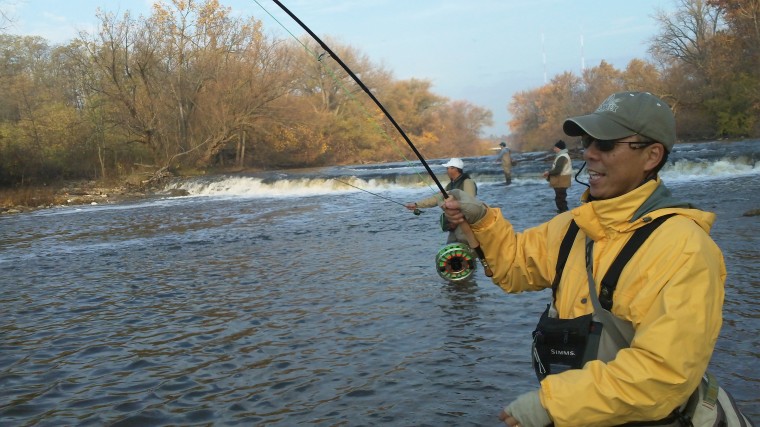 |
| Fly Anglers Target Wisconsin Steelhead |
Or, now we are seeing a lot more women anglers, particularly (so it seems) in flyfishing. But the blogosphere and magazine journalism of fishing is still pretty well dominated by men authors. So we're hearing a lot of men's perspectives on fishing, but not as many women's. Likewise, are the women we see representative of all the women who fish? I'll go ahead and say I'm seeing a lot of young, fit white women from the U.S. and Canada. Are they the only women anglers? (hint: no) Where are the rest? And, what has been the history of women in fishing? If this is a new phenomenon, what spawned it? Has there been and will there be "gender wars" in fishing?
 |
| Women Fish in Snotty Conditions, too. |
We can't pretend or presume that the world of fishing is somehow immune to the social inequalities that plague so many other aspects of our society and others. And the sooner we recognize and acknowledge that, the sooner we can move to understanding and resolving those issues.
We need to step back for a second and realize who we are and what we do. We can learn about our social environment at the same time we learn about the habits of our quarry. Maybe it's okay to think like a fish, but like a fish out of water, able to see it's habitat in new light, from another being's perspective, aware of itself in a way it hasn't been before.
I'll be using space on this blog to do my part.
-T.A.
 |
| It's mutual. |
I'll be using space on this blog to do my part.
-T.A.
Friday, February 1, 2013
Miami Vise
Last night, I booked a flight to Miami for a work trip in early April. Like all you anglers out there, I'm going to squeeze in whatever fishing I can--casting the beach, cracking my skull on a jetty, wading in the mud, renting a kayak--whatever it takes. So I've already been at the vise spinning up some creatures.
On this edition of "Miami Vise," we have:
The MarlBug:


El Camaron (Spanish for shrimp), a variation on Borski's slider:


I hope you like. More importantly, I hope the seatrout, bones, reds, and jacks of south FL like...
And I just got a big shipment of the best saltwater fly hooks, so you'll know I'll be tying my ass off until April.
On this edition of "Miami Vise," we have:
The MarlBug:
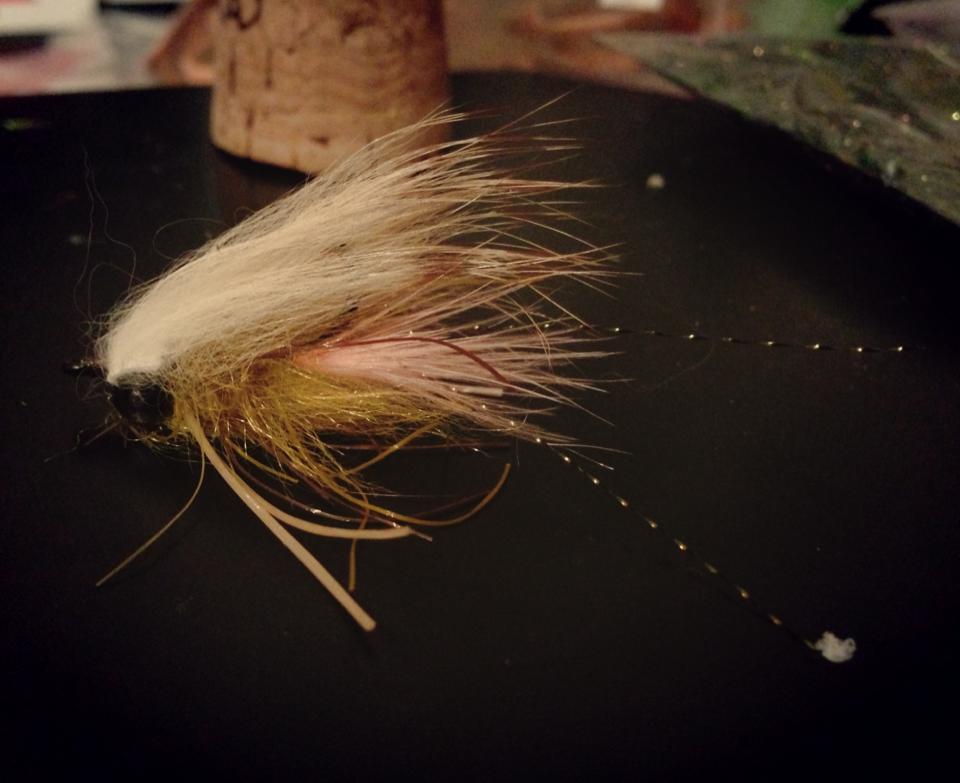

El Camaron (Spanish for shrimp), a variation on Borski's slider:


I hope you like. More importantly, I hope the seatrout, bones, reds, and jacks of south FL like...
And I just got a big shipment of the best saltwater fly hooks, so you'll know I'll be tying my ass off until April.
Subscribe to:
Posts (Atom)